Digital SAT Scoring 2026: How Your Score Really Works
Your Digital SAT score is not simply the percentage of questions you answered correctly. This guide explains the 400-1600 scale, adaptive modules, question difficulty, score estimates, and the official sources behind the process.
Free estimate. No sign-up. Not affiliated with College Board.
Digital SAT scoring in 60 seconds
- Total score: 400-1600.
- Reading and Writing: 200-800, with 54 questions in 64 minutes.
- Math: 200-800, with 44 questions in 70 minutes.
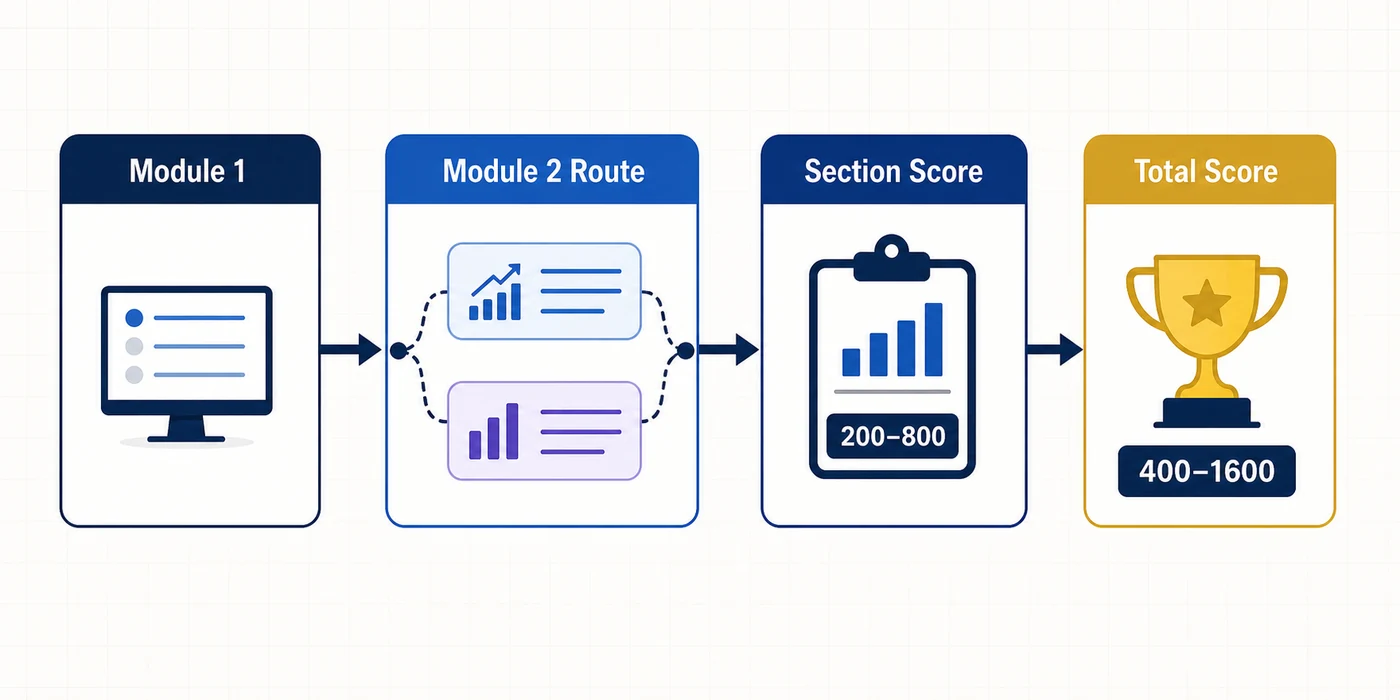
- Adaptive design: Each section has two modules. Module 1 performance helps determine the difficulty of Module 2.
- Score calculation: College Board uses Item Response Theory to account for answer correctness and question characteristics.
The 2026 Digital SAT score structure
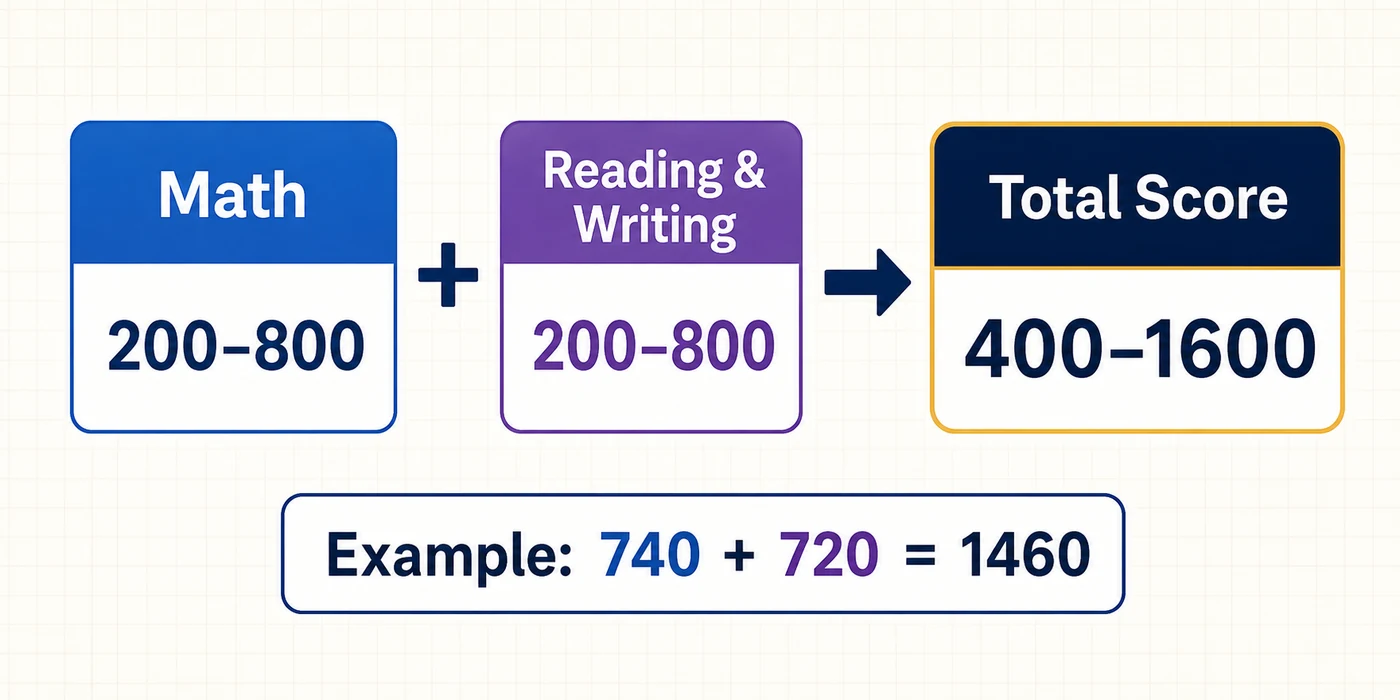
The Digital SAT produces one total score and two section scores. The total is the sum of Reading and Writing plus Math. The format and scale used in 2026 remain:
Official format details are documented in the College Board Digital SAT Suite test specifications.
How Digital SAT scoring works
1. Each section begins with Module 1
Every student starts with a first module containing a broad mix of question difficulty. The test evaluates performance within that section before routing the student to the second module.
2. Module 2 adapts to Module 1 performance
Students are routed to a higher- or lower-difficulty second module based on Module 1 performance. This happens separately for Reading and Writing and Math. Your Math route does not determine your Reading and Writing route.
3. The scoring model evaluates more than raw accuracy
College Board explains that Digital SAT scores are based on whether answers are correct, question difficulty, and the statistical characteristics of the questions. The system uses Item Response Theory, often shortened to IRT, to place performance on the 200-800 section scale.
4. Section scores are added together
Reading and Writing and Math are each reported from 200 to 800. Adding them produces the 400-1600 total score. For example, a 710 Reading and Writing score plus a 760 Math score equals a 1470 total score.
Why there is no universal raw-score conversion table
Because test forms, adaptive routes, and question characteristics vary, a single "X correct equals Y points" chart cannot reproduce every official Digital SAT score. A conversion chart is useful for planning, but it should be treated as an estimate.
View our estimated score conversion chartDigital SAT scoring example
Suppose a student reviews a practice test and enters these module results into an independent estimator:
Math
Module 1: 20 of 22
Module 2: 18 of 22
Example estimate: 740
Reading and Writing
Module 1: 24 of 27
Module 2: 21 of 27
Example estimate: 720
Illustrative total
1460
This is an estimator example, not an official College Board conversion. The official score for the same number correct can differ because question difficulty and test form matter.
Can the same number correct produce different scores?
Yes. Two students can answer the same total number of questions correctly and receive different section scores. They may have taken different Module 2 routes, answered questions with different statistical characteristics, or received different test forms.
This does not mean the scoring is arbitrary. College Board uses statistical methods to make scores comparable across different forms. The practical takeaway is that raw accuracy is an input, not the final score formula.
How to use your score report
A total score gives you a quick benchmark, but section scores are more useful for planning. Compare Math with Reading and Writing, identify the weaker section, and then review the content domains shown in your practice results.
SAT Math Score Calculator
Enter both Math modules for a broad practice-score estimate.
Reading and Writing Calculator
Estimate your section score and focus your next practice session.
How Digital SAT Adaptive Scoring Works
Learn what the two-stage design does, what College Board publishes, and which routing details remain unpublished.
Next, compare your estimate with our SAT percentile guide and read what counts as a good SAT score for your target schools.
Four common Digital SAT scoring myths
Myth 1: Every question is worth a fixed number of points
A 1600-point scale divided by 98 questions does not reveal the point value of a question. The official model is not a simple points-per-question formula.
Myth 2: One mistake always costs the same number of points
The score effect of a missed question can vary by test form and by the statistical characteristics of the items.
Myth 3: Getting the easier Module 2 means you failed
It means Module 1 performance routed you to a lower-difficulty module. You can still earn a valid score and use the results to identify what to study next.
Myth 4: An online calculator can promise an exact score
Independent calculators are planning tools. Only College Board can issue an official SAT score.
Digital SAT scoring FAQ
What is the Digital SAT score range in 2026?
The total score range is 400 to 1600. Reading and Writing is scored from 200 to 800, and Math is scored from 200 to 800.
Is Digital SAT scoring based only on how many answers are correct?
No. College Board says scoring considers whether each answer is correct, question difficulty, and the statistical characteristics of the questions. The adaptive route through Module 2 also matters.
Can two students with the same number correct receive different scores?
Yes. Because students may see different questions and Module 2 difficulty paths, the same raw number correct does not guarantee the same scaled score.
Is there a penalty for guessing on the Digital SAT?
No points are deducted for incorrect answers. If time is running out, answering every question is better than leaving questions blank.
Can a raw-score conversion chart predict my exact SAT score?
No. A chart or calculator can provide a planning estimate, but an official score depends on the specific test form, question characteristics, and adaptive path.
Official sources
This guide uses College Board materials for the test format and scoring methodology. Visit the official pages for the primary source details.
Turn your practice results into a score estimate
Enter correct answers for all four modules and get an instant Math, Reading and Writing, and total score estimate.
Try the Free CalculatorEstimates only. Official scores are issued by College Board.